
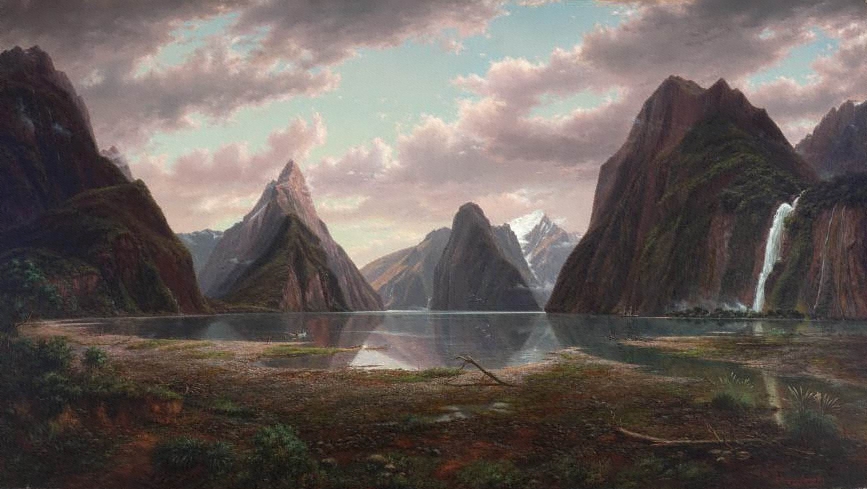
After viewing a wide range of artworks at the NSW Art Gallery, the one that made the strongest impression on me was Eugene Von Guerard’s painting “Milford Sound” as it captures the sublimity of nature brilliantly. This painting amplified my understanding of Romanticism as it dismisses Enlightenment ideals that focused on scientific reason and hierarchal status, but rather depicts the sublimity of nature. This notion of nature being superior and powerful was a typically Romantic concept.
I was instantly mesmerised by the vastness of the landscape Von Geurard has painted. My eyes were drawn to the salience of the lake, and then my eyes wandered up the mountains and into the sky. These layered elements of nature intensify the capacity of the landscape, accentuating its sublimity and thus our inferiority as humans who are minuscule in comparison to the immensity of the landscape. The large mountains that stand tall and seemingly reach into the sky remind us humans of our place in the world, humbling us into realising our subservience to nature. Also, the soft colours deliberately chosen by Von Guerard, such as gentle hues of purple, blue and grey further establish the beauty of nature which was a core theme in the works of Romantic-era writers. Furthermore, the wide shot used to capture the extensiveness of the scenery highlights the infinite quality of nature, alluding to its transcendence as the scenery extends beyond the confinements of the artwork’s small frame, suggesting that the beauty and superiority of nature is beyond human comprehension. This alludes to Romantic ideas of nature being sublime and evoking a sense of wonder and awe from the viewer.
Overall, my “virtual” excursion to the NSW Art Gallery profoundly deepened my understanding of literary themes such as Romantic ideas of nature. This was achieved by appreciating a multitude of artworks, specifically Eugene Von Guerard’s ‘Milford Sound’ which evoked a highly emotive response and stimulated a deep appreciation for the natural world.
 Literature with Anna