A Powerful Poem

For my final blog I decided to reflect on the literature we have read and explore the power of one of the poems I found to be most interesting. That is W.B Yeats’ ‘A Prayer For My Daughter’. This poem explores Yeats’ concern for his daughter’s future and the person she will grow up to be. It highlights the turmoil of existing in a modern world that can be superficial and cruel, yet his hope that his daughter will grow up to be someone who embodies internal beauty in spite of this. I think this is a powerful message as it criticises the world and society we live in whilst simultaneously encouraging individuals to seek internal beauty rather than superficial beauty.

The poem begins with the persona, who we assume to be Yeats himself, praying for his daughter. He uses personification to describe a thunderstorm that is “howling, and half hid” while his daughter is “under the cradle-hood and coverlid”. The juxtaposition between a violent storm and peaceful sleeping baby suggests Yeats’ hope that his daughter will be unharmed by the world around her. It implies that the persona is desperate to protect his daughter from more than just a physical storm, but the cruelty of contemporary society.

At the beginning of stanza three Yeats goes on to say what I personally found to be one of the most powerful lines in the poem: “may she be granted beauty and yet not beauty to make a stranger’s eye distraught, or hers before a looking-glass, for such, being made beautiful overmuch, consider beauty a sufficient end, lose natural kindness and maybe the heart-revealing intimacy that chooses right, and never find a friend”. Here, he suggests his desire to protect his daughter from undesirable attention as sometimes physical beauty can attract harm. This is because people are too concerned with the physical beauty of things and forget about the more important internal beauty, such as kindness and humility. Thus suggesting that he wants his daughter to embody qualities of internal beauty rather than letting society brainwash her into becoming overly-concerned with physical appearance. This is a message that I believe is important and powerful as it is applicable to all readers as everyone has fallen victim to societal beauty standards at some point in their life.

Experiencing the life of Prufrock

I have read T.S Eliot’s poem “The Lovesong of J.Alfred Prufrock” a myriad of times, in fact I have even done a blog on it before (https://literaturewithanna.art.blog/2019/09/27/the-lovesong-of-j-alfred-prufrock/). However, when reading it, I have never once tried to relate to the persona’s experiences or pondered how I too have felt his loneliness and boredom.

To reiterate what was said in my previous blog and give a brief overview of the poem; “T.S Eliot’s modernist poem ‘The Lovesong of J.Alfred Prufrock’ is set in a dull city, and its protagonist is a disconsolate man who is afraid of living and therefore feels bored within a monotonous society… Eliot insightfully explores how the mundane, ritualistic nature of modern society can leave one in a state of emotional paralysis”.

Although being written in 1915, I think this poem has profound significance in a modern society, specifically due to the Coronavirus. We have been encouraged to limit our social interactions and have been forced to work and study from home, making life feel mundane and dull, which is exactly what Prufrock talks about. Personally, I enjoy going out, seeing my friends, eating at cafes and even studying in my uni’s library. Yet this absurd situation has taken away these pleasures in life, helping me to relate to Prufrock. This shared sense of boredom within one’s life is something that Prufrock and I have therefore both experienced.

T.S Eliot uses a wide range of language devices to convey Prufrock’s experience. Through synecdoche, I understand Prufrock’s observation of “arms that are braceleted and white and bare,” to exemplify isolation from people as he fails to see them as whole. This sense of isolation is especially relevant living in a Covid infected world as social distancing has made us almost forget how to interact with other people.

Overall, I think that in a current society experiencing Covid-19, T.S Eliot’s “The Lovesong of J.Alfred Prufrock” makes for a good read as we can find similarities between Prufrock’s perspective on life and our own.

The Love Song of J. Alfred Prufrock….(Abridged) | Thus I Wrote
Image Retrieved From: https://thusiwrote.com/2015/01/21/the-love-song-of-j-alfred-prufrock-abridged/

The Realities of War as depicted by Wilfred Owen

How do Wilfred Owen’s poems show the harsh realities of war, specifically the way that war strips people of their humanity?

Wilfred Owen’s poem ‘Anthem For Doomed Youth’ depicts the sense of doom and tragedy that is evoked by war. He uses a range of language devices to establish this notion of dehumanisation through war, such as the simile “what passing-bells for these who die as cattle?”. Here, Owen asks us to ponder on the way that human beings treat each other in war, comparing the traumatised soldiers to dead cattle. This line really resonated with me as it perfectly captures the harsh realities of war, conveying the way that soldiers in war are killed like slaughtered animals and the lack of dignity these young men obtain when being treated this way. Through Owen’s words, it is highlighted that death was something so common that the tyrants waging war essentially desensitised the horror of battle. Hence, Owen challenges readers to take on the experiences of these soldiers and elicit pity and mercy for these young men that are essentially ‘doomed’.

After the lecture, I also went on to read Owen’s poem ‘Insensibility’ which further establishes the way that war strips people of their humanity. The repetition of “their” in the 3rd Stanza (“their spirit” … “their old wounds”) dehumanises the soldiers as they are not referred to by name, and by third person, thus desensitising their souls. There is no burden of their souls, for they are desensitised. The scars of war no longer ache as their blood is drained from them, when they die. The harsh weather, the cold winter days and nights, have made them become unaware of their physical, emotional and psychological wounds. Furthermore, the metaphor of “men, gaps for filling” depicts the young men as commodities who are put as replacements for the soldiers that have died. This line does not consider the young men who are fighting for their country as being their own individual person, but rather a necessity to winning a war, simply filling up a gap. Overall, conveying similar ideas seen throughout Owen’s poetry and exposing to us the harsh realities of war.

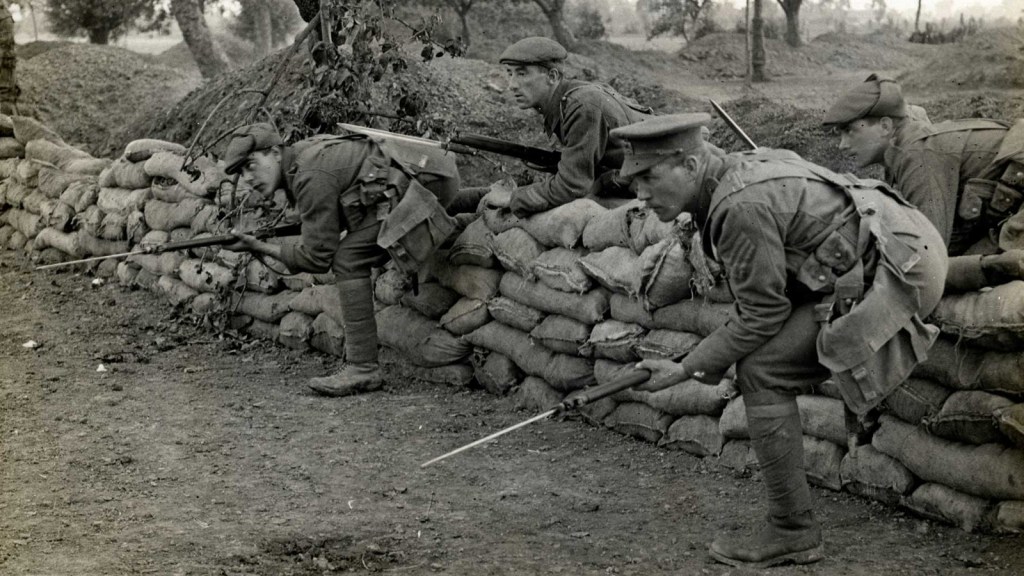
‘Life as a Soldier’, The British Library