
After listening to this week’s lecture and closely analysing Du Bois’ writing, I am able to realise the power and essentiality of his message. Du Bois confronts the pervasive issue of racism through the infamous statement; “the problem of the twentieth century is the problem of the colour-line”. This significant statement refers to the continuous discrimination that African American people encounter on a regular basis, despite countless historical movements and icons that have advocated for equality and freedom. Subsequently, Du Bois seeks to gain answers as to why racism still exists within the twentieth century, and establishes the concept of the ‘colour-line’. To me, the ‘colour-line’ essentially refers to the division between Europeans and African Americans due to the colour of one’s skin. It is the notion that human nature prevents us from acquiring equality and acceptance, as it is human nature to think that anyone or anything that is different from us, is bad. Du Bois confronts society into questioning their morality, and how one can justify the act of mistreating people and refusing them from attaining their human rights due to the colour of their skin. Du Bois’ statement demands us to take notice of the racism that is still present in a contemporary society as well as the inequities of power. The concept that a person can be inferior to others simply because of their race is brought into question. I think that Du Bois’ teaching is a pivotal one, and that society must be reminded of the way we judge and mistreat one another, and how this prevents us from living in a liberated society built on acceptance and equality.
Author: Anna Castagnella
Reviewing Bruno’s Blog
Link to Bruno’s Blog: https://brunosliteratureblog.wordpress.com/2019/08/19/living-deliberately/comment-page-1/?unapproved=126&moderation-hash=0672bfa42042fd5562062a197fbe6e87#comment-126
Hi Bruno, I’ve chosen to read your blog as I answered the same question and was curious to see how someone else interpreted this task. I particularly like the way you explained your thought process when answering this question. You put deep consideration into what the phrase “living deliberately” really means which was clear through your description of a monotonous routine; “eight hours a day, five days a week…”. I also really like the metaphor that you used by comparing society’s complacency to being “mindless zombies that live their life based on routine”. My only recommendation is use some evidence/quotes from Thoreau’s text to back up what you’re saying and strengthen your points. Overall, I think you did a really good job at answering this question and this is a great piece of writing 🙂
Write a poem in the style of Walt Whitman
This Old Mandarin Tree
I celebrate and sing myself as I climb through the tree!
Climb a little higher!
Children’s laughter rings through my ears.
The gorgeous sun beams against my back,
A sensational feeling!
My name is called but I run farther away, determined to make it to the top.
I slide from branch to branch,
Gliding with ease, every movement memorised.
Arm, leg, lift. Left arm, right arm. Pull.
Green leaves, summer breeze, wonderful life!
My small steady hands. Swift and quick!
I reach the tree’s end and gaze at the top of passing strangers’ heads.
The summer sky is luminous for the grey clouds have gone home to rest.
Birds flying, people gathering, and the wind is singing!
It sings a melody so euphonious, my ears are in Heaven!
From the top of this old mandarin tree I am invincible!
I can see everything from here but nothing sees me.
I will never come down!
I rest against a branch and pick a mandarin to eat.
Peel its skin, let its divine flavour fill my insides.
Bliss! Every one of my senses is ignited!
The leaves move in the wind and I close my eyes,
Embracing her gentle hands that push my hair back.
The sky has turned a mesmerising orange!
The sun kisses my nose!
We hold each other tight and find comfort in one another’s company.
This is home. Right here. This feeling is home.
From this soil, these roots, these leaves;
They are me.
I celebrate and sing them!

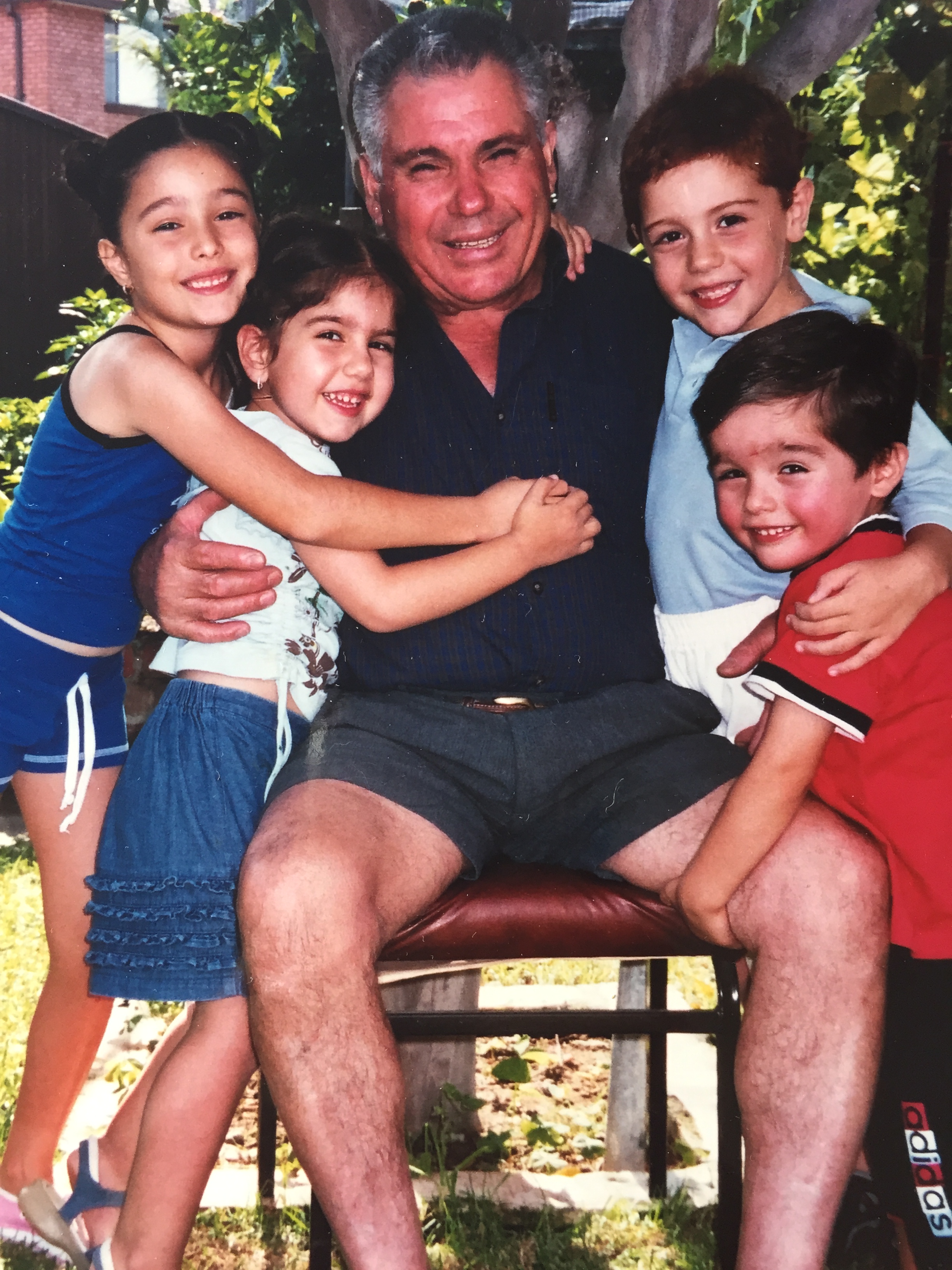
Some photos of my cousins and I in my Nonno’s garden, besides “the old mandarin tree” 🙂
Reviewing Teneille’s Blog
Link to Teneille’s Blog: https://thebestofliterature.art.blog/2019/08/18/the-rink/
I really enjoyed reading Teneille’s blog this week as I thought it was a very original and creative interpretation of the question. Her response was able to elucidate a clear emotional attachment to the place where she grew up, yet she did this through a profound use of figurative language. I was able to clearly visualise what she was describing as she takes time to really describe each detail of ‘the rink’ as well as how she felt whilst being there. I think it would be interesting for Teneille to experiment with her writing as she is very creative and obviously has potential to write unique pieces of work. For this reason, I would have loved to see this in the form of a poem or another text type. Overall, she did a really good job and I look forward to reading more of her blogs.
Reviewing Evelyn’s Blog
Link to Evelyn’s work: https://literaturetalk.home.blog/2019/08/25/realism-vs-idealism/comment-page-1/?unapproved=5&moderation-hash=78fdebd66ef4a6aab96cb4dd2614ea8a#comment-5
Hi Evelyn, I really enjoyed your analysis of the two authors as you clearly have a good understanding of their writing and how Henry Lawson is a “realist”, whereas Banjo Paterson is an “idealist”. You have provided good insight regarding their work and a clear justification as to why you prefer Lawson’s writing. I think you could have structured this in a different way to make your argument better, and essentially easier to understand. Perhaps including the quotes in your paragraph rather than putting them at the end? or splitting this into two separate paragraphs, focusing one on Paterson and the other on Lawson. Also, watching your punctuation and editing your work after writing may also assist in bettering your argument (use of commas, apostrophe ‘s’ when saying ‘Lawson’s poetry’, capitalisation of ‘I’, etc). Overall, you have done some great analysis of this week’s readings, and have made efficient comparisons between the two authors, thus competently answering the question. Looking forward to reading more of your blogs 🙂
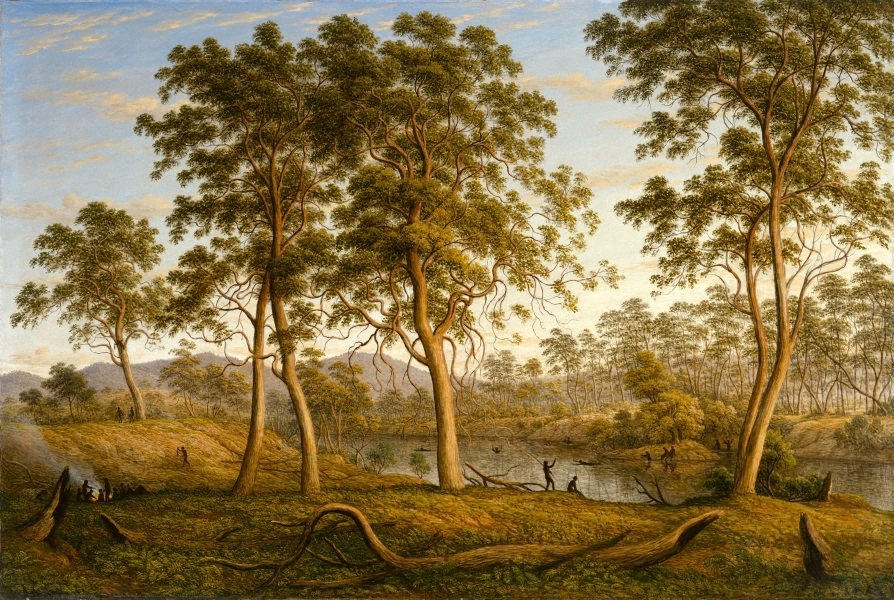
Take any single Australian painting that you saw at the gallery and write a description in prose – Ekphrastic Writing.
Blue skies surround them, shining sunlight on their motherland that is one with them. The indigenous people desperately grasp onto every remaining aspect of the natural landscape. The refreshing water of the lake, glistening amid the green and brown grass. The trees tower over them, safeguarding them from the impending threat of intrusion. Long trumps of brown wood and leafy green hair populate the landscape, stretching so high, seemingly reaching for the sun to soak in her warm embrace. The people take comfort in the golden rays of sun on their skin and the fresh air in their lungs. They rely on the mountains that stand tall and large in the background to shelter them from any potential threat. Smoke from the fire they’ve created to cook their food and warm their hands, fades into the scattered puffs of misty grey clouds. The clouds are so faded as if they’re preparing to vanish into the wind, leaving nothing behind but the luminous sun to inhabit the pale blue sky. Under these skies, their surroundings are sublime. The sound of the beaming sun accompanied by euphonious nothingness brings serenity, knowing that this piece of land has yet to be polluted by loud men in peculiar clothing. Whilst the lake is overflowing with life and jubilance, they are aware that this tranquillity is only temporary. Simply waiting for the strange men to disturb more of what does not belong to them.
Write a stanza of a poem in the style of Banjo Paterson.
I gaze up at the sky, only to be met with the sun’s harsh stare,
“We’re lost!” I shout, but nobody listens, ignoring me and the cries of my aching feet,
I linger behind their stubborn footprints and hope, yet doubt, that we’re almost there
But when the moon rises and I’m proven right, the feeling is bittersweet.
The trees peer down at us, mocking our aimless walking
As we desperately try to remember our way back,
Beyond the sound of our childish squabbles, we are silenced by the euphony of water falling,
We smile at the waterfall and I can’t help but think, oh I’m so glad we lost our track.


What do you understand by Thoreau’s intention to ‘live deliberately’? Can you possibly explain this basing it in your own experience of life right now?
What does it mean to ‘live deliberately’? It is the realisation that there is a difference between truly living and merely existing, and thus choosing to take control of your own life in order to ensure a sense of fulfilment. It is a hunger to live a life that exceeds the societal barriers which force people into complacency and monotony. It is a question we all ask ourselves in one way or another, stemming from a universal fear of the uncertainty that comes with death. Thoreau comments on the passivity of human existence, urging us to seek purpose in our lives and live life with intent. He reflects on his decision to embark on a journey within the woods as he seeks to live a life away from materialism, distancing himself from an indifferent society in order to establish spiritual enlightenment as he believes this will bring him ‘purpose’.
Thoreau’s essay ‘Walden’, or ‘Life in the Woods’ profoundly intrigued me and was strangely relevant to me during this time in my life as I too have been pondering on such existential ideas. I have questioned the meaning of life countless times; and whether or not I’m even doing it right as if there is a correct way to live. You do not truly acknowledge the frailty of life until it is almost taken away from you. When encountering a near-death experience, at first you are shocked and overwhelmed at how short life really is. Next, you find the motivation to grasp onto the aspects of life that you enjoy and focus only on them; this is what I believe Thoreau means by “front only the essential facts of life”. Recently, my mum and I were in a frightful car accident and because of this Thoreau’s intention behind writing this essay genuinely resonates with me as he highlights the importance of truly engaging with life rather than simply going through the motions as one day there will be an end. The line which resonated with me the most after enduring such an experience was, “when I came to die, discover that I had not lived”. An underlying tone of regret is present to me in this particular quote, perhaps Thoreau had a similar epiphany to me and realised the changes he must make in order to ensure that when his life ends, it will have been one that he was proud to have lived. This thought provoked me to reconsider my own awareness of my intent to live deliberately, and I encourage you to do the same.
 Literature with Anna